

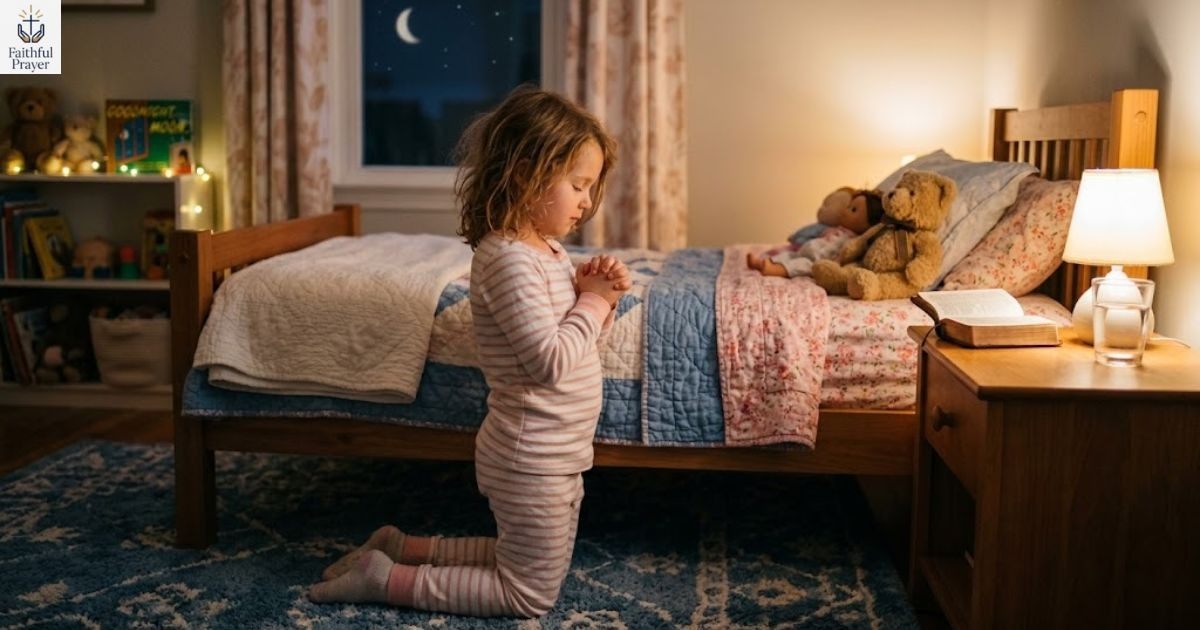
Going to bed can be a peaceful time to slow down, leave daily worries behind, and place your trust in God. For generations, families have used the Now I Lay Me Down to Sleep prayer as a simple bedtime prayer for children and adults. Its short lines are easy to remember and focus on God’s care, protection, and guidance during the night.
The traditional prayer is especially known for its words about asking the Lord to keep and care for the soul. Over time, several gentler versions have also become popular, especially for children who may feel uncomfortable with its reference to death. This guide explains the full prayer, its meaning, history, biblical connections, modern versions, and practical ways to use it as a nightly Christian prayer.
Now I Lay Me Down to Sleep Prayer
The traditional Now I Lay Me Down to Sleep prayer is one of the best known Christian bedtime prayers. Its simple rhyme makes it easy for children to learn, while its message gives adults a short way to express trust in God before going to sleep. The prayer focuses on placing one’s soul in God’s care during the night.
Although wording has changed slightly across different publications and generations, the familiar version has remained remarkably stable. The traditional wording is connected with an older Christian bedtime tradition and became widely known through publications such as the New England Primer.
Now I lay me down to sleep,
I pray to the Lord my soul to keep.
If I should die before I wake,
I pray to the Lord my soul to take.
Amen.
These four lines express a complete bedtime prayer. A person prepares to sleep, asks God to watch over the soul, recognizes human uncertainty, and places ultimate trust in God.
Modern Now I Lay Me Down to Sleep Prayer
Many families prefer a modern version because the traditional line about dying before waking can sound frightening to a young child. Modern versions keep the familiar opening while replacing that part with words about angels, protection, peace, and morning. This makes the prayer feel more reassuring while keeping its Christian bedtime purpose.
A modern bedtime prayer can also be personalized. Parents may mention a child’s name, thank God for the day, ask for peaceful sleep, or pray for family members. The goal is not to create a fixed formula but to help a person end the day with faith and trust.
Now I lay me down to sleep,
I pray to the Lord my soul to keep.
May angels watch me through the night,
And wake me with the morning light.
Amen.
This version places greater emphasis on safety through the night and waking with a new morning. Similar modern adaptations are commonly presented as gentler alternatives to the traditional wording.
What Does Now I Lay Me Down to Sleep Mean?
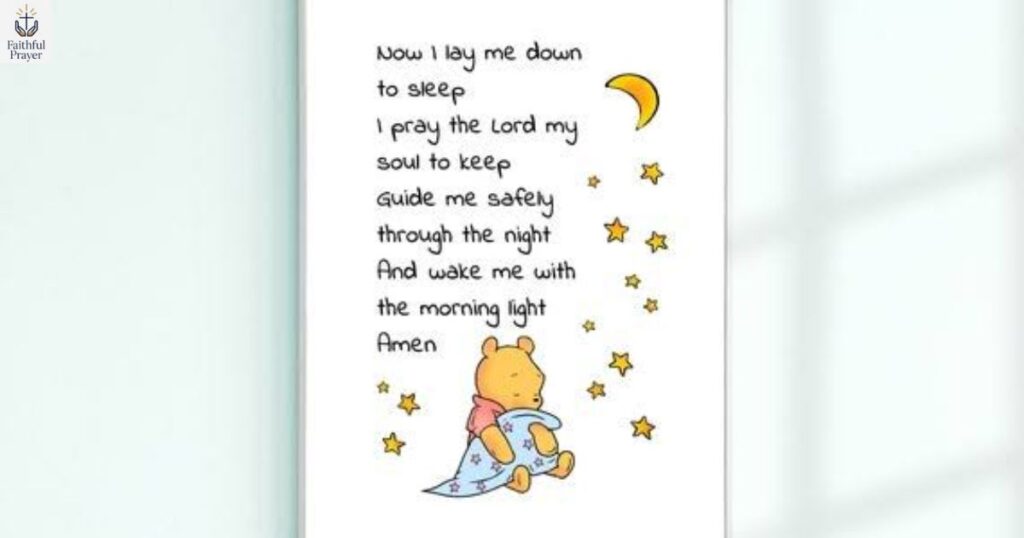
At its heart, the prayer is about trust. Going to sleep means giving up control for several hours, so the prayer uses bedtime as an opportunity to acknowledge dependence on God. “I pray the Lord my soul to keep” expresses a desire to remain under God’s care while resting.
The prayer also reminds believers that life is uncertain. Its traditional wording does not promise that every night will be exactly the same; instead, it places life and death in God’s hands. For many Christians, this makes the prayer an expression of faith, surrender, humility, and hope rather than simply a children’s rhyme.
Meaning of “Now I Lay Me Down to Sleep”
The opening line describes a simple physical action: preparing to rest. Spiritually, it can represent a moment of slowing down after a busy day and becoming quiet before God.
Bedtime can be a natural time for reflection. A person may think about what happened during the day, give thanks for blessings, ask forgiveness, and place tomorrow’s concerns in God’s hands.
Meaning of “I Pray the Lord My Soul to Keep”
This line expresses trust in God’s protection and care. The word “soul” gives the prayer a deeper meaning than a simple request for physical safety.
It points toward spiritual dependence on God. Instead of relying only on personal strength, the person praying acknowledges God as the one worthy of trust and asks Him to watch over their life.
Read More: Prayer to Saint Michael: Powerful Prayers for Protection and Spiritual Strength
Meaning of “If I Should Die Before I Wake”
This is the line that many modern versions change for young children. Historically, it reflects an older Christian awareness that human life is uncertain and that prayer can prepare a person to place their life in God’s hands.
The wording does not mean that death is expected during sleep. It recognizes a possibility that humans cannot control. For believers, the following line turns that uncertainty into an expression of faith in God.
Meaning of “I Pray the Lord My Soul to Take”
The final traditional line completes the prayer by returning to God’s care. It expresses confidence that a person’s ultimate spiritual life belongs with God.
For adults, this can be a reminder of Christian hope and eternal life. For children, parents can explain it in simple and comforting language according to their family’s beliefs.
Is Now I Lay Me Down to Sleep in the Bible?
No. The Now I Lay Me Down to Sleep prayer is not a direct Bible passage. It was written as a traditional Christian bedtime prayer and later became widely used in Christian homes. Its words are not found as a four line prayer in Scripture.
However, its themes are strongly connected with biblical ideas about sleep, safety, trust, prayer, and God’s care. Several Bible passages speak about lying down peacefully, sleeping under God’s protection, and trusting Him through the night.
Biblical Themes Behind the Prayer
| Prayer Theme | Related Biblical Idea |
| Peaceful sleep | God gives peace and safety |
| Protection | God watches over His people |
| Trust | Believers can depend on God |
| Nighttime rest | Scripture describes sleeping under God’s care |
| Morning | Waking can be seen as another gift of God |
| Prayer | Christians are encouraged to bring concerns to God |
| Hope | Faith looks beyond temporary circumstances |
The connection is therefore thematic rather than a claim that the traditional prayer appears word for word in Scripture. This distinction is important when explaining the prayer to children or adults studying Christian prayer.
Bible Verses Related to Bedtime Prayer
Several Bible verses fit naturally with a Christian bedtime prayer. Psalm 4:8 is especially close to the central idea because it connects lying down and sleeping with dwelling safely under God’s care. Psalm 3:5 also connects sleep and waking with God’s sustaining presence.
These passages can be read before or after the Now I Lay Me Down to Sleep prayer. Families can choose one verse each night or use a small group of verses as part of a longer evening devotion.
Psalm 4:8
“I will both lay me down in peace, and sleep: for thou, Lord, only makest me dwell in safety.”
This verse is one of the clearest biblical connections to a nighttime prayer. It presents sleep as a time when a person can rest in God’s protection.
Psalm 3:5
“I laid me down and slept; I awaked; for the Lord sustained me.”
This verse connects sleeping and waking with God’s sustaining care. It can be especially meaningful for someone who feels anxious about going to sleep.
Proverbs 3:24
“When thou liest down, thou shalt not be afraid: yea, thou shalt lie down, and thy sleep shall be sweet.”
The verse presents peaceful sleep as part of a life marked by trust in God’s wisdom. It can work well as a short Scripture reading before a bedtime prayer.
Psalm 91
Psalm 91 is widely read as a passage about God’s protection and refuge. Its themes of shelter, safety, and trust make it a natural choice for a longer nighttime devotion.
Psalm 121:7–8
Psalm 121 speaks about God keeping and watching over His people. Its closing words focus on God’s care in daily life and provide a meaningful foundation for a prayer before sleep.
Philippians 4:6–7
Philippians 4:6–7 teaches believers to bring worries and requests to God through prayer. Its message about God’s peace can be especially helpful when nighttime brings anxious thoughts.
History of Now I Lay Me Down to Sleep Prayer
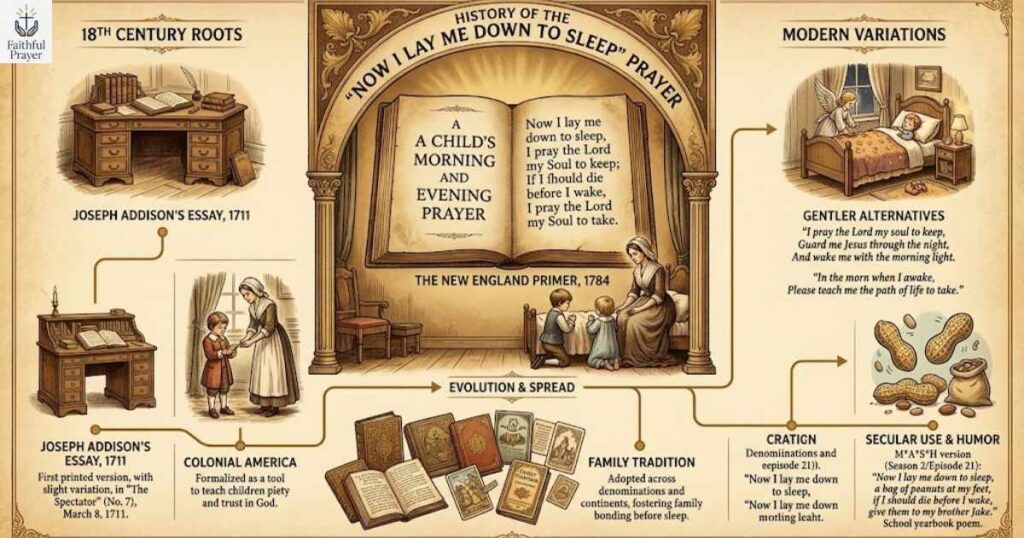
The exact origin of the prayer is not completely certain. The familiar form is strongly associated with the New England Primer, where it appeared in an early edition from 1737. Thomas Fleet is associated with that publication, and later editions helped spread the prayer among English speaking families.
At the same time, researchers and historical sources point to earlier related bedtime prayers. One source identifies a version published by George Wheler in 1698 that includes the idea of lying down to sleep and giving the soul to God’s care. Because related prayers existed before the familiar version, it is safer to describe the prayer as part of a long tradition rather than assign its entire origin to one person.
A Simple Historical Timeline
| Period | Historical Development |
| 1600s | Related English bedtime prayers and nursery prayers circulated |
| 1698 | George Wheler published a related bedtime prayer |
| 1711 | Joseph Addison wrote a passage with similar nighttime surrender themes |
| 1737 | A familiar form appeared in the New England Primer |
| 1800s | Versions continued appearing in books and nursery collections |
| 1840 | A related version appeared in J.G. Rush’s London Jingles |
| Modern era | Families continue using traditional and adapted versions |
This history shows why the prayer has many slightly different wordings. It developed through repeated publication and oral family traditions rather than remaining tied to one single standardized text.
Who Wrote Now I Lay Me Down to Sleep?
There is no universally established single author for the familiar prayer. Some sources have connected it with Joseph Addison, while historical discussion also points to earlier prayers that contain similar ideas and wording. Because of these different records, saying that Addison definitely wrote the entire prayer would be too certain.
The strongest documented point is that the familiar form was printed in the New England Primer in the eighteenth century. Earlier related versions mean that the prayer likely developed from a broader bedtime prayer tradition rather than appearing suddenly from one writer.
Why Do Children Say This Bedtime Prayer?
Children often learn this prayer because it is short, rhythmic, and easy to memorize. Its repeated wording allows parents to teach a child a simple nightly habit without requiring a long prayer or complicated vocabulary.
A bedtime prayer can also create a peaceful transition from daytime activity to nighttime rest. Parents may use it alongside a Bible story, gratitude, a hug, or a short conversation about the child’s day.
Benefits of a Bedtime Prayer for Children
- Creates a consistent nighttime routine
- Helps children learn simple Christian prayer
- Encourages trust in God
- Gives children words for expressing fears and worries
- Creates a peaceful transition toward sleep
- Gives parents an opportunity to pray with children
- Encourages gratitude and reflection
- Introduces children to biblical themes
- Builds a family tradition
- Helps children remember that prayer can happen at any time
The value of a bedtime prayer does not depend on saying exactly the same words every night. A child can eventually learn to speak naturally to God about family, school, friendships, fears, hopes, and gratitude.
A Gentle Bedtime Prayer for Children
Young children may respond better to a prayer that focuses on love, safety, and morning rather than mortality. A parent can choose a gentle version while still teaching the basic Christian idea of trusting God before sleep.
A child’s bedtime prayer can also be personal. Parents may add the names of siblings, grandparents, friends, teachers, or anyone the child wants to remember in prayer.
Dear God,
Thank You for this day and for all the good things You have given me.
Thank You for my family and for those who care for me.
Please watch over me while I sleep tonight.
Give me peaceful rest and keep me safe through the night.
Help me wake with a happy and thankful heart.
Guide me tomorrow and help me make good choices.
Bless my family and everyone I love.
In Jesus’ name, Amen.
This prayer can be shortened for very young children or expanded as children become more comfortable with personal prayer. The important part is helping them understand that prayer is a way to communicate with God.
A Traditional Bedtime Prayer for Adults
Adults can also use the Now I Lay Me Down to Sleep prayer. Although it is commonly associated with children, its themes of surrender, mortality, trust, and spiritual care can speak to adults as well.
For adults, the short prayer can become an opening for a longer nighttime devotion. After saying the traditional words, a person may thank God for the day, confess mistakes, pray for family, ask for wisdom, and surrender tomorrow’s concerns.
Heavenly Father,
As I prepare to sleep, I place this day in Your hands.
Thank You for carrying me through every difficult moment and every blessing.
Forgive my mistakes and help me learn from them.
Please watch over my family and those I love.
Give me peaceful rest and quiet my anxious thoughts.
Help me trust You with everything I cannot control.
Guide me when I wake and give me strength for a new day.
Keep my heart close to You through every season of life.
In Jesus’ name, Amen.
This type of evening prayer can be especially useful after a stressful day. It creates a deliberate moment to stop thinking about unfinished tasks and turn attention toward faith, gratitude, and peace.
Prayer for Peaceful Sleep and Protection
A prayer for peaceful sleep does not need to be long. Many people simply want a few quiet moments before bed to ask God for protection, calm, and rest. The traditional prayer can serve this purpose, or it can be combined with Scripture and personal requests.
A peaceful nighttime prayer can also acknowledge worries without allowing them to dominate the final moments of the day. Instead of trying to solve every problem before sleeping, a person can place those concerns before God and rest with faith.
Lord,
Thank You for bringing me safely through this day.
Please protect me and my family through this night.
Calm my mind and remove fear from my heart.
Help me release every worry I cannot solve tonight.
Give me peaceful and restful sleep.
Watch over my home and everyone I love.
When morning comes, give me renewed strength, wisdom, and hope.
Amen.
The Four Angels and Four Corners Prayer
The Four Angels prayer is related to a broader tradition of nighttime prayers, but it should not automatically be presented as part of the original four line Now I Lay Me Down to Sleep prayer. Historical versions sometimes combine different bedtime traditions, which can make their origins appear more connected than the evidence establishes.
The Four Corners tradition includes imagery of angels around a sleeping person. Related versions have appeared alongside other nighttime prayers, and some modern families use the idea as a comforting prayer for children.
A Modern Four Angels Bedtime Prayer
Four angels around my bed,
Watching over me as I rest my head.
One to watch and one to pray,
Guard me safely through the night.
May God’s love surround me,
And bring me safely to morning light.
Amen.
This modern wording is a family prayer rather than a claim about the historical original. It keeps the comforting imagery of protection while placing God at the center of the prayer.
Traditional vs Modern Bedtime Prayer
The traditional and modern forms share the same basic purpose, but their wording creates a different emotional tone. The traditional version directly mentions death and the soul, while many modern versions emphasize angels, protection, peaceful sleep, and morning.
Neither wording has to be used by every family. Parents can choose the form that fits their child’s age, understanding, family tradition, and Christian beliefs.
| Feature | Traditional Version | Modern Version |
| Opening | Now I lay me down to sleep | Now I lay me down to sleep |
| Main theme | Trust and surrender | Protection and reassurance |
| Soul | Directly mentioned | Often retained |
| Death | Directly mentioned | Often removed |
| Angels | Usually not included | Often included |
| Morning | Not emphasized | Often mentioned |
| Tone | Serious and traditional | Gentle and comforting |
| Common use | Traditional Christian bedtime | Modern family bedtime |
| Length | Very short | Usually short |
The main message remains similar: a person goes to sleep while placing trust in God.
Why Some Parents Prefer a Modern Version
The phrase “if I should die before I wake” can raise questions for young children. Some children may begin worrying about death at bedtime, particularly if they already struggle with nighttime fears. For this reason, modern versions often replace that wording with a request for protection and a safe morning.
This does not mean the traditional version is wrong. It simply means families may choose language that fits a child’s emotional and spiritual understanding. Historical sources also document versions that remove the reference to death.
When a Traditional Version May Be Meaningful
- When a family already knows and values the traditional wording
- When an older child asks about its meaning
- When adults use it as part of personal prayer
- When a family wants to preserve a generational tradition
- When its themes of trust and surrender are understood clearly
When a Gentle Version May Be Helpful
- For very young children
- For children who fear nighttime
- For a new bedtime routine
- When parents want to focus on peace and protection
- When a child asks for a prayer about waking safely
The best approach is to explain unfamiliar words rather than simply expecting a child to repeat them without understanding.
How to Pray Before Going to Sleep
There is no required method for saying a Christian bedtime prayer. A person can pray while sitting beside the bed, kneeling, lying down, or praying together with family members. The physical position matters less than the sincerity of the prayer.
A simple routine can make nighttime prayer easier to maintain. Families can choose a regular time, keep the prayer short, and gradually add Scripture or personal requests as children become older.
A Simple Night Prayer Routine
- Slow down
Put away distractions and take a quiet moment. - Give thanks
Thank God for blessings from the day. - Reflect
Think about something that went well and something that needs forgiveness or improvement. - Ask for forgiveness
Bring mistakes honestly before God. - Pray for others
Remember family members, friends, and people who need help. - Ask for protection
Pray for safety and peaceful rest. - Release worries
Give tomorrow’s concerns to God. - Read Scripture
Choose a short Bible verse about peace, trust, or protection. - Say a bedtime prayer
Use the traditional prayer or a personal version. - Rest
End the day with gratitude and trust.
A routine like this can turn a short bedtime prayer into a meaningful nightly devotion without making bedtime complicated.
How Parents Can Teach This Prayer to Children
Parents can teach the prayer one line at a time rather than asking a child to memorize all four lines immediately. Repeating the same words each night can make the prayer familiar, while explaining each line helps a child understand its meaning.
Children can also be invited to add one personal sentence after the traditional prayer. For example, a child might thank God for family, pray for a sick friend, or ask for help with school. This gradually teaches that prayer is more than memorizing words.
Simple Teaching Method
- Say one line slowly.
- Let the child repeat it.
- Explain difficult words.
- Connect the prayer with a simple Bible verse.
- Let the child add a personal request.
- End with “Amen.”
- Keep the routine peaceful and consistent.
As children grow, parents can introduce longer prayers and Scripture readings. The short bedtime prayer can remain a familiar foundation even after a child learns to pray independently.
A Family Bedtime Prayer
Family prayer can make bedtime feel less like a private task and more like a shared spiritual tradition. Parents and children can sit together, hold hands, or simply remain beside one another while each person takes a turn praying.
A family does not need a long ceremony. Even a few minutes of gratitude, Scripture, and prayer can provide a peaceful ending to the day. The routine may become a meaningful memory that children carry into adulthood.
Dear Lord,
Thank You for our family and for bringing us through another day.
Thank You for food, shelter, love, and every blessing we received today.
Forgive us for our mistakes and help us become kinder and wiser.
Protect our home tonight and watch over everyone in our family.
Give each of us peaceful sleep and a calm heart.
Help those who are worried, sick, lonely, or afraid.
Bring us safely into a new morning and guide our steps tomorrow.
Help our family grow in faith, love, patience, and kindness.
In Jesus’ name, Amen.
This prayer can be changed according to family needs. Children may also be encouraged to add their own requests before everyone says goodnight.
Short Night Prayer for Children
Sometimes a child is already tired and needs a very short prayer. A simple prayer can still express gratitude, protection, and trust without becoming a long bedtime activity.
Short prayers are also useful for children who are learning to pray independently. Once they know the basic structure, they can gradually replace memorized words with their own simple sentences.
Dear God,
Thank You for today.
Please watch over me while I sleep.
Keep my family safe and give us peaceful rest.
Help me wake with joy tomorrow.
Amen.
Another very short option is to say the traditional Now I Lay Me Down to Sleep prayer and then add one personal sentence. This keeps a familiar family tradition while giving the child space for personal prayer.
Night Prayer for Peace and Anxiety
Nighttime can become difficult when the mind keeps returning to worries about school, work, relationships, money, health, family, or tomorrow’s responsibilities. Prayer cannot be treated as a guarantee that every concern will disappear immediately, but it can provide a structured way to bring those concerns before God.
A person can name specific worries instead of trying to hide them. After naming them, the prayer can shift toward trust, gratitude, and surrender. Bible passages about peace and God’s care can also become part of this routine.
Lord,
My mind is full of thoughts tonight, and I need Your peace.
You know every concern that is troubling me.
Help me release what I cannot control.
Give me wisdom for what I can change and patience for what I must wait for.
Protect my heart from fear and help me rest.
Let Your peace guide my thoughts as I prepare to sleep.
Give me strength for tomorrow and remind me that I do not have to carry everything alone.
Amen.
This type of prayer can be used before or after the traditional bedtime prayer. A person can also repeat a short Scripture phrase that brings attention back to peace and trust.
What Makes This Prayer Special?
The prayer has survived for centuries because it is simple enough for a child but meaningful enough for an adult. Four short lines address sleep, the soul, uncertainty, and trust in God. That combination gives the prayer a depth that goes beyond its nursery rhyme style.
Its continued use also comes from family tradition. Parents teach it to children, children later remember it as adults, and some eventually teach it to their own families. This creates a connection between generations through a short Christian bedtime prayer.
Reasons Families Continue Using It
- It is easy to memorize.
- It takes only a few moments.
- It introduces children to prayer.
- It encourages trust in God.
- It creates a consistent bedtime routine.
- It can be combined with Scripture.
- It can be adapted for different ages.
- It connects generations.
- It can be used by children and adults.
- It provides a simple ending to the day.
The prayer does not need elaborate words to carry meaning. Its strength comes from its simplicity and from the personal faith of the person saying it.
Can Adults Say Now I Lay Me Down to Sleep?

Yes. There is nothing about the prayer that limits it to children. Its traditional wording addresses universal themes such as mortality, spiritual care, surrender, and trust in God. Adults can say it exactly as traditionally written or use it as a starting point for a longer evening prayer.
Adults may also appreciate its simplicity after a busy day. A short familiar prayer can help create a pause before sleep and remind a person to place worries, plans, and uncertainties in God’s care.
For adults, the prayer can be followed by:
- A prayer for family
- A prayer for forgiveness
- A prayer for wisdom
- A prayer for protection
- A prayer for peaceful sleep
- A prayer of gratitude
- A Bible verse
- A personal request
- A prayer for tomorrow
- A moment of silent reflection
This makes the traditional bedtime prayer useful as part of a larger Christian nighttime routine.
How to Personalize the Prayer
A memorized prayer can become more meaningful when it is followed by personal words. After saying the traditional four lines, a person can speak naturally to God about what happened during the day and what is on their heart.
Personalization is especially helpful for children. Instead of making every night identical, parents can ask a child what they are thankful for and whom they want to remember in prayer. This turns bedtime prayer into a conversation about faith and daily life.
Personal Prayer Prompts
Before sleeping, consider praying about:
- Something you are thankful for
- Someone who helped you today
- Someone who needs prayer
- A mistake you want to correct
- A fear you want to surrender
- A decision that needs wisdom
- A family member
- A friend
- Tomorrow’s responsibilities
- Your relationship with God
These prompts can be changed every night. They also help a person move from memorized prayer toward a personal and sincere prayer life.
Is the Traditional Prayer Scary for Children?
The traditional line about dying before waking can sound serious, especially to very young children. Some children may simply repeat the words without concern, while others may ask questions or become afraid. Parents can respond calmly and explain the words according to their family’s Christian beliefs.
There is no requirement to use the traditional wording with every child. A modern bedtime prayer can keep the focus on God’s love, protection, peaceful sleep, and morning. Historical sources document several adapted versions that remove or soften the reference to death.
A Gentle Explanation for a Child
A parent might explain that the traditional prayer is about trusting God with every part of life. The line about death is not meant to tell a child that something bad is going to happen during the night.
The parent can then explain that Christians believe God cares for people during life and that they can pray whenever they feel afraid. If a child remains uncomfortable, the family can choose a gentler version instead.
How This Prayer Connects With Christian Faith
The prayer expresses several important Christian themes without attempting to summarize all Christian teaching. Trust in God, prayer, spiritual care, surrender, and hope are central ideas that can be explored through Scripture and personal devotion.
Its wording also reminds believers that bedtime can become a spiritual moment. Instead of ending the day only with entertainment or unfinished thoughts, a person can pause, give thanks, and remember God’s presence.
Main Faith Themes
| Theme | Meaning |
| Trust | Depending on God rather than relying only on ourselves |
| Surrender | Giving worries and uncertainty to God |
| Protection | Asking for God’s care during the night |
| Faith | Trusting God during vulnerable moments |
| Peace | Seeking a calm heart before sleep |
| Gratitude | Remembering blessings from the day |
| Hope | Looking toward God beyond present circumstances |
| Prayer | Communicating honestly with God |
| Family | Sharing faith through a nightly routine |
These themes make the prayer useful as a starting point for deeper Christian devotion. A short prayer can open the door to Scripture reading, personal reflection, and longer prayer.
A Good Night Prayer for the Whole Family

A family may want a prayer that includes children, parents, grandparents, and loved ones who are not physically present. This can be especially meaningful during holidays, difficult seasons, or times when family members need encouragement.
The prayer below is intentionally broad so it can be used by families with different routines. It can be shortened, expanded, or followed by the traditional Now I Lay Me Down to Sleep prayer.
Loving God,
Thank You for staying with us through this day.
Thank You for every moment of joy, every lesson, and every blessing.
Please watch over our family tonight.
Protect our home and give each person peaceful rest.
Comfort anyone who is worried, sick, lonely, or facing a difficult situation.
Give us wisdom when we wake and help us treat others with love and kindness.
Forgive our mistakes and help us do better tomorrow.
Keep our hearts close to You and guide our family in Your ways.
Bring us safely into a new morning.
In Jesus’ name, Amen.
A family can end by saying the traditional prayer together. This creates a simple rhythm that children can remember and repeat even when they are away from home.
Five Common Versions of the Prayer
Different families may use different wording while keeping the same central idea. Some versions are traditional, some are modern, and others are personal adaptations created for a particular family or child.
The following examples show how the prayer can change while preserving its purpose. These are not all historical originals; some are modern devotional adaptations designed for different bedtime needs.
Traditional Version
Now I lay me down to sleep,
I pray the Lord my soul to keep.
If I should die before I wake,
I pray the Lord my soul to take.
Amen.
Gentle Children’s Version
Now I lay me down to sleep,
I pray the Lord my soul to keep.
May angels watch me through the night,
And wake me with the morning light.
Amen.
Protection Version
Now I lay me down to sleep,
I pray the Lord my soul to keep.
Guard my home and family tonight,
And bring us safely to morning light.
Amen.
Peaceful Sleep Version
Dear Lord, as I close my eyes,
Fill my heart with peaceful thoughts.
Watch over me throughout the night,
And give me restful sleep until morning.
Amen.
Family Version
Lord, thank You for this day.
Watch over everyone we love tonight.
Give our family peace, safety, and rest.
Guide us through tomorrow and keep our hearts close to You.
Amen.
These examples show that a bedtime prayer can be short or personal. What matters most is that its words fit the person praying and express sincere faith.
FAQs
What is the Now I Lay Me Down to Sleep prayer?
It is a traditional Christian bedtime prayer that asks God to watch over and care for a person during sleep.
Is Now I Lay Me Down to Sleep in the Bible?
No, this prayer is not directly found in the Bible. However, its themes connect with biblical teachings about sleep, protection, peace, and trusting God.
Who wrote Now I Lay Me Down to Sleep?
The exact author is uncertain. A familiar version appeared in the New England Primer in the 1700s, while earlier related bedtime prayers also existed.
Can children say this prayer before bed?
Yes. It is commonly used as a children’s bedtime prayer and can help create a peaceful nightly prayer routine.
Can adults say Now I Lay Me Down to Sleep?
Yes. Adults can use it as a short nighttime prayer or combine it with personal prayers and Bible verses.
Conclusion
The Now I Lay Me Down to Sleep prayer remains a familiar Christian bedtime prayer because its message is simple and memorable. The traditional version expresses trust in God’s care, while modern versions often focus more directly on peaceful sleep, protection, angels, and morning light. Its history reaches back several centuries, with the familiar form documented in the New England Primer and related bedtime prayers appearing even earlier.
The prayer is not a direct Bible passage, but its themes connect naturally with Scripture about sleep, peace, safety, trust, and God’s care. Whether a family chooses the traditional wording or a gentle modern adaptation, bedtime can become a meaningful moment to pray, give thanks, release worries, and trust God before beginning a new day.
